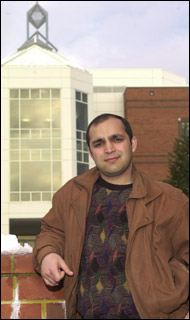
Fawad Muslim

Brave New World
Alumnus steers his native Afghanistan toward a technology solution
By Robin Herron
Fawad Muslim, B.S. Computer Science '00, finds himself leading a major information technology effort in a country where most people have never even seen a computer. Although this task may seem daunting, for a young man who has been setting and surpassing goals since he was a teenager, nothing is impossible.
Failure has seldom been in the cards for Muslim. Arriving in the United States at age 14 with his family as an Afghan refugee, Muslim plunged into studies and work. Placed in seventh grade when he started school in Virginia, he caught up to complete high school with his peers. He worked full time while going to school from age 16 on to help support his family as well as relatives in Afghanistan.
Computer Science Professor David Rine, who taught Muslim at Mason and keeps in touch with him, says, "Fawad is a hard-working young engineer. While completing his B.S., he simultaneously held down a number of jobs to support his extended family, pioneered the development of the Free Afghan radio station and news service, and pioneered the development of the Afghan web site, all in order to tell the world what was happening in Afghanistan."
Working on the radio program and maintaining the web site kept Muslim on top of current events and acquainted him with people who would later serve in the post-Taliban government. When the new government was inaugurated in December 2001, Muslim went to Kabul to take part in the reconstruction of his war-torn native land without any ambition for an important position in the government. But the next week, Afghan Foreign Minister Abdullah Abdullah, who knew of Muslim's skills in information technology, asked Muslim to start up an Information Technology Department in that ministry.
"I thought about it and decided it was the best time to help the country. If I were to come back 10 years from now and say, 'I want to help,' that's not going to be a great help. This is the best time to help rebuild this country, because there's not a whole lot of people who know technology," Muslim says.
He moved in with a cousin in Kabul and began plans to put the Foreign Ministry, which owned five Pentium I computers, on a technology fast track. He encountered skepticism from his Afghan colleagues when he told them about bringing computers, the Internet, and networked systems to the ministry.
Muslim proved them wrong, quickly amassing a fleet of nearly 200 computers by appealing to countries around the world. The most significant contribution came from India, which, after Muslim's persistent prodding, provided a satellite dish in April 2002 to connect the ministry to the Internet. Muslim says that acquisition has been his biggest achievement.
Besides inspiring confidence and cooperation from his dubious colleagues, Muslim's feat allowed the foreign ministry to communicate quickly and cheaply with the foreign ministries of other countries, as well as with its own embassies and consulates around the world. E-mails and e-faxes have saved the ministry the $10 per fax page it had been paying.
Muslim also began an ambitious training program for foreign ministry employees, which he later extended to employees of some of the other 28 government ministries. He set up two-month training sessions to teach Microsoft Windows, Word, Excel, and Access. He started with 60 employees; the most recent session had 400 trainees. By his estimate, 900 employees have successfully graduated, and his goal is to train 2,000 by year's end.
At the foreign ministry, which Muslim boasts is "the most wired
place in the country," about 80 percent of the computers are networked
and more than two-thirds of the 500 employees know how to use a computer. "My
plan is to computerize the whole system of the foreign ministry within
two years."