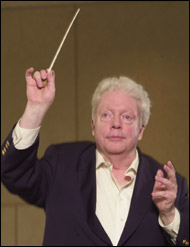
Stephen Douglas Burton
That Familiar Little Ditty
Mason composer gives historical perspective to a song we all know by heart
When the world heard on news broadcasts Saddam Hussein singing "Happy Birthday" to one of his daughters in an old videotape, it caused many people to scratch their heads and wonder, "Happy Birthday"? In Iraq?
According to Stephen Douglas Burton, Mason's Heritage Chair in Music, the answer is "yes—in China, Japan, and even Iraq."
Although the song has humble beginnings in Louisville, Ky., where it was written in the late 1800s by the Hill sisters, the American Society of Composers, Authors, and Publishers in 2000 deemed it the most often performed song of the century, says Burton.
"'Happy Birthday' has enjoyed worldwide distribution for more than a century," he says, noting that the song was first published in 1893 in a songbook that went through 20 editions in six languages, including Chinese and Japanese. The song has been sung to kings and presidents (Who can forget Marilyn Monroe's rendition to President Kennedy?), performed in space, and included in countless films. Some believe it was the film exposure that made the difference.
"The song has appeared in literally hundreds of films—at up to $50,000 in royalties per film," says Burton, who is an expert on film music and regularly teaches the popular course Music in Motion Pictures for music and nonmusic majors. "This may also explain why in Germany, Japan, and Russia, the song is most often sung in English. While dialogue is generally dubbed in the language of the country, musical numbers are normally left in the original language."
A composer himself, Burton continues, "My own feeling is that the form of the melody has a great deal to do with the popularity of the piece—it is easy to remember! It consists simply of a short six-note motive (melodic fragment) to the words 'happy birthday to you.' Then the words repeat and the motive repeats a step higher; it repeats a third time yet higher and merges into a fourth repetition coming back down again, a perfect arch form or what Leonard Bernstein used to call the 'ready (1) aim (2) fire (3 + 4)' method of composition."
Burton can take that analysis a step deeper. "Mildred Hill's study of Negro spirituals undoubtedly had a strong influence on this type of motivic construction, not to mention the chantlike repetition of the words—which incidentally gives you time to think of the person's name before you have to sing it."
"Of course, the fact that there are many appropriate occasions when the song can be sung has a great deal to do with the frequency of its performance," he notes. "Yet, there is no one dominant song for any other event." Burton has found sources that estimate the song is sung more than 17 million times daily around the world.
The royalties collected from the song each year would themselves make quite a lovely birthday gift. Summy-Birchard Music, a part of the AOL Time Warner conglomerate, owns the rights to the song, and its president, David Sengstack, estimates that "Happy Birthday" brings in about $2 million in royalties annually. These royalties are split between Summy-Birchard and the Hill Foundation, whose share goes to charity and the Hill sisters' nephew Archibald Hill (none of the four sisters ever married or had progeny).
Does this mean that we have all been violating its copyright by singing "Happy Birthday"? "Not at all," says Burton, "only if we sing it for profit, charge admission, sell recordings, or perform it in public."
Still, there is a lot to admire about those six simple notes. "Symmetry,
repetition, and variation—all used to make the tune both memorable and
interesting," says Burton. "Even I can sing that."