The Young Economists
High school students explore the world of experimental economics
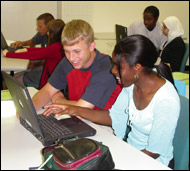
"Continuing my education—even in the summer—is important to me. Opportunities like this weren't available to me in Ethiopia," says Etsegent Firdaweke, a student who has lived in Alexandria, Va., for the past three years. The opportunity she refers to is the Vernon L. Smith High School Workshop in Experimental Economics offered through the Interdisciplinary Center for Economic Sciences (ICES) at George Mason University.
During this second year that ICES has offered the workshops, rising high school juniors and seniors and recent high school graduates from across the nation studied economics in a hands-on laboratory environment. This experimental approach was pioneered by the workshop's namesake, Vernon L. Smith, a professor of economics and law at Mason who won the 2002 Nobel Prize in Economic Sciences.
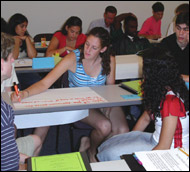
In each of three five-day sessions this summer, approximately 24 students learned economic principles and came to understand how market rules affect the behavior of individuals and the performance of the market as a whole from Mason Economics Professor Bart Wilson, an enthusiastic supporter of the program who brings that energy to his teaching. Working from 9 a.m. until 3 p.m. on the Arlington Campus, the students began the day with an economics experiment in which they earned cash if they made economic decisions that benefited them financially. Patrick Starr, a student from Falls Church, noted that the payments were an added bonus, but even when students didn't earn a payment, it was still fun. The morning experiment was followed by a lecture and another experiment or discussion problem. The day ended with a team problem. Game theory, auctions, public goods, and electricity markets were some of the topics Wilson explored with the students.
Students from Virginia, who made up a large percentage of the attendees, received college credit for the workshop from Mason. "Not only do students gain credit in the program," says Wilson, "they also gain practical knowledge above a standard high school or introductory economics college course. In addition, students develop friendships while solving and discussing economic team problems and strategies with their peers."
The program is made possible primarily by the International Foundation for Research in Experimental Economics, a nonprofit organization that supports outreach workshops to introduce students and teachers to the methodology of experimental economics.
For more information on ICES, its people, and its programs, visit ices.gmu.edu.