
Build a Bot
Graduate and middle-school students join forces for an unusual summer camp
By Christopher Anzalone, BA History ’05 and BA Religious Studies ’05, and Colleen Kearney Rich, MFA ’95
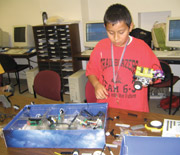
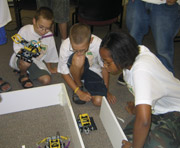
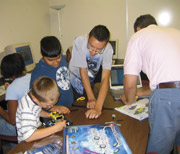
 For a group of middle-school students, the answer to “What did you do on your summer vacation?” made them the envy of their classmates. These students, who ranged in age from 10 to 15, spent a week in August on the Fairfax Campus building robots as part of the Robotics Enrichment Camp.
The camp is the brainchild of Debra Sprague, associate professor in the College of Education and Human Development (CEHD). In the spring, she and her graduate students began looking for ways to counteract the trend of a rising number of middle school students losing interest in academics, specifically mathematics and science.
“We wanted to find an interesting and fun way to reach these students,” says Sprague. “We thought robotics might be a way to generate an interest in science, math, and engineering, while helping students develop skills they could use in college and a future career.”
The students used Lego® Mindstorms™ robot kits and Yoiks! and MicroWorlds computer programs, which are designed to teach computer concepts and programming. Students conducted a scavenger hunt using global positioning system equipment and designed simple machines that could get a raw egg from the top of a table to the floor without breaking it. The camp culminated in a robot challenge that required the students to maneuver a robot they built and programmed through a maze they designed.
In addition, Sprague was able to offer scholarships to students who might not have been able to attend a summer camp because of cost. To help finance the camp’s operations, she received donations from several local businesses, including Wal-Mart, K-Mart, Barnes and Noble Booksellers, McDonald’s, Target, and Staples. Alexandria City Public Schools provided transportation for their students who attended the camp.
Graduate students in CEHD’s Instructional Technology Program ran the camp, and although the primary focus was on teaching concrete computer, math, science and engineering concepts, Sprague also wanted to change the students’ perspectives on the process of learning.
“One of the reasons we start to lose children at this age is because they do not see learning as fun,” she says. “They associate learning with schooling, which can be boring and isn’t very motivating. We made a concerted effort to not do any ‘school’-related activities but to make the camp exciting, hands-on, and engaging.”