

Ghost Buster
Fairfax County librarian seeks source of local legend
Any story involving a weapon-wielding grown man dressed in a bunny suit tends to be remembered. When the details get juicy—hatchets, axes, mutilated animals, murdered children, bodies hanging from bridges—an investigation may be in order. At least, if you’re a historian with a passion for tracking down the truth.
Enter Brian Conley, BA History and Psychology ’88, the Fairfax County Public Library’s historian–archivist. An information specialist in the Virginia Room at the library’s Fairfax City branch, Conley is often called on by the public to dig up anything from house deeds to old photographs. He’s also, at times, a ghost hunter, a seeker of urban legends. And he’s got a picture of the hatchet to prove it.
Let’s back up a little. Conley first heard about the Bunny Man more than 20 years ago. As a good story will, it stuck with him, especially since he grew up in Clifton, Va., the site of a railroad bridge that is said to be home to the Bunny Man legend.
The Bunny Man story, which has circulated Northern Virginia and Maryland for decades, has been featured in high school newspapers and on the Internet, and even had a segment on the “Scariest Places on Earth” television show. Although ghosts appear in some versions of the story—for instance, some say if you go to the bridge on Halloween, the Bunny Man’s ghost will appear and kill you at midnight—many of the versions Conley has heard center around vandalism or murders that are said to have happened years ago and aren’t focused on any supernatural aspects.
Many area residents continue to be intrigued by the legend, and after getting inquiries about it at the library, Conley decided to turn detective and hunt for the origin of the Bunny Man. “Most legends have some basis in truth,” he says.
Conley started his search with the Fairfax County Public Library Historical Newspaper Index, seeking gruesome murders or murders involving children in Fairfax County between 1872 and 1973. He came up with three possible crimes but was frustrated when none of them seemed to connect to the legend. Eight years passed until Conley came up with his first solid lead. The Maryland Folklore Archive had a student paper within its collection titled “The Bunny Man.” In the paper, the student mentioned she had found a Washington Post article that “verifies the story as truth.”
Conley ran a search of Post articles from October 1970, about the time the Maryland student first heard about the legend, and got lucky. He found a news article about a couple sitting in their car on a rural road in Fairfax County when a man dressed in a white bunny suit jumped out of nearby bushes and threw a hatchet through their car window. The man shouted something about trespassing on private property and then disappeared.
Finally, Conley had what he suspected was the start of all the hoopla. “A man running around in a bunny suit is just plain weird,” Conley says. “It’s the kind of thing that reporters would jump all over and the kind of thing that people remember.”
Conley published his discovery in a paper, “The Bunny Man Unmasked: The Real Life Origins of an Urban Legend,” which can be found on the Fairfax County Public Library web site. About a year ago, he received a phone call from a woman who said she and her husband, then fiancé, were the young couple in the car attacked by the Bunny Man. She told Conley that she and her husband still have the hatchet, and it took them hours to pull all the glass out of her hair. She sent Conley a picture of the hatchet and the scrapbook she kept about the incident.
No one to this day knows the Bunny Man’s identity or what provoked his bizarre behavior, but Conley believes it was a reaction to the development going on in Fairfax County in the 60s and 70s as subdivisions and shopping centers replaced pastures and woods. “Being forced to watch helplessly while the face of your community changes around you can elicit strange behavior in some people,” he wrote in his article.
But even now, Conley cannot begin to hazard a guess about the bunny costume. Some mysteries are just not meant to be solved.
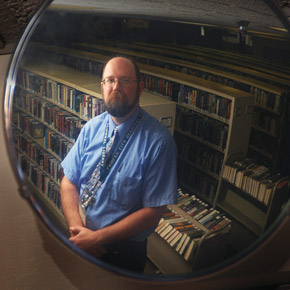
Brian Conley