A Labor of Love
Education alumna helps establish Salvadoran University
By Amy Biderman
"Let’s go to El Salvador and start a university.” Those words marked a turning point in the life of Barbara Acosta, PhD Education ’05. It was 1990, and she had just been awarded a full fellowship to a doctoral program when her husband, Francisco, made that life-changing statement.
After much deliberation—and many sleepless nights—Acosta decided to put her doctoral degree on hold and join Francisco in his mission. “We wanted to establish a university to promote long-term peace through education and help people raise themselves up by their bootstraps,” she says. So, with their daughters, then ages 1 and 4, the Acostas traveled to Chalatenango Province—one of the areas hardest hit during El Salvador’s 12-year civil war.
The university would be named after Oscar Romero, archbishop of San Salvador, who was assassinated in 1980 while celebrating mass. Francisco Acosta had served in a seminary with Romero and also faced threats on his life. He eventually left the seminary and El Salvador, living in Mexico and Canada before settling in the United States in 1984. Barbara Acosta met him shortly after that and they married in 1985.
“Francisco was seen as a facilitator of reconciliation, and people looked to him to help end the war,” Acosta says. “He brought people together from many sides of the issue.”
The Acostas laid the groundwork for the university during the final two years of the war. The peace accords contained a commitment to recognize civilian initiatives, and the law of higher education allowed the Acostas to proceed. They gathered six other people into a group that had what Acosta describes as “a great vision”: providing higher education to students from poor families from both sides of the conflict who generally were excluded from such programs.
Oscar Romero University was established in 1994, just two years after the peace accords were signed. Initially offering only three academic programs, the university was housed in an abandoned farmhouse on an old battlefield. Over time, the university expanded to 10 acres just a few miles from the original site.
“We had to get rid of land mines and related vestiges of the war,” Acosta explains. “We then started with a group of dedicated professionals who traveled from the capital, which was two and a half hours away, to provide classes on weekends.”
More than 800 students are enrolled at the nonprofit, nondenominational institution. It is modeled, in part, after a community college, as well as the original Antioch College work-study concept, which blends classroom learning with practical experience. Both 2-year technical and 5-year bachelor’s degrees are offered. With no government funding, the university operates mainly on tuition income and private donations.
While tuition is only $1,200 a year, “even that small amount is a burden on rural families,” Acosta says. “Some families—headed by widows and single women—make a dollar a day.”
The university has established a private scholarship fund to cover half the tuition. Full scholarships are not offered because Salvadorians believe that “you don’t give things away for nothing or they are not valued,” Acosta says. Approximately 40 students currently receive scholarships; 100 more are on a waiting list.
“What we’re trying to do is very much in the framework of social justice,” Acosta notes. “We feel that one of the best ways to promote a peaceful democratic society is through education. The contribution we can provide is to form leaders to work with the community and establish a culture of peace.”
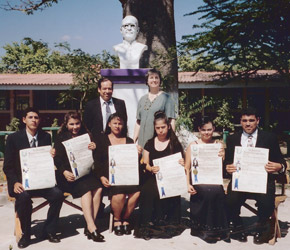
Barbara Acosta with graduating students from the School of Education, Oscar Romero University