Mason Memories
A Look Back at Life at Bailey’s Crossroads
In September 1961, I started my career at George Mason College, which at the time was a two-year liberal arts branch of the University of Virginia. The student body numbered just over 120 full- and part-time students.
Back then, Mason was only several years old with few traditions and no cliques. Most of the students had been 12th graders only 3 months earlier, so the culture was partly high school and otherwise made up as we went along. With the tiny campus and small classes, there was no hiding, no anonymity. There was no choice; everybody had to be somebody.
Beyond the anxiety of being a new college student, I frequently had twinges of an inferiority complex—and I wasn’t alone. While it soon became obvious we were doing college-level work under the direction of a capable faculty, we had a nagging sense that we weren’t really at college. You couldn’t help reflecting on being an outcast, stuck at a decrepit former elementary school (aka the Little Red Schoolhouse), while your buddies were away at four-year colleges and universities. Plus, I’d gotten in on sheer chance, and the more people I met, the more I thought that perhaps the whole student body was defective. Many, including myself, were there because of the college’s growth strategy to admit high school graduates who had some promise but an imperfect academic record. Some had tried other colleges and failed (or given up). Others were perpetual students, just weren’t ready, or couldn’t afford to leave home. For many, Mason offered a last chance, and they took it.
But as time went on, the Little Red Schoolhouse at Bailey’s Crossroads (BXU to its fans) won our fond respect; its quirky shortcomings helped cement the bonds of friendship. The void in culture filled quickly. Social and educational events grew; a newspaper, a yearbook, the Honor Code, and cliques appeared as the student population reached critical mass. It became commonplace to brag about the Little Red Schoolhouse to friends who went to the name universities. While certainly some did fail academically, having the personal support of the entire community, both students and faculty, was a tremendous encouragement. People who came intending to stay for only a stop-gap semester fell under the spell of the Little Red Schoolhouse and stayed on.
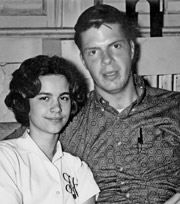
I did my two years and went part time for a third while attending American University. That year, working as a lab assistant at the college, I met my future wife. The next year, the college moved to Fairfax, and I went along, working for the Biology Department, eventually ending up as an instructor. I taught a lab on the day I was married.
I finished my undergraduate degree at George Washington University. In 1970, I returned to Mason to complete my master’s degree in biology. By then, it was a brand-new university.
Richard Sparks (MS Biology ’73) is a freelance photographer and artist. His booklet, Life at Bailey’s Crossroads, 1961–1964, has been added to the online collection of the University Libraries’ Special Collections and Archives (www.gmu.edu/library/specialcollections/ mason_history1.pdf). The Richard Sparks Collection also includes an oral history interview with Sparks and his wife, Ann, an alumna of George Mason College (1965).
~
Do you fondly remember certain places within the George Mason community that exemplified the “college experience”? Were you befriended by a mentor or professor at George Mason who influenced your life? If so, tell us about it. Send your submission to Alumni Affairs, George Mason University, 4400 University Drive, MS 3B3, Fairfax, VA 22030. Please keep submissions to a maximum of 500 words.
Professors We Love
Do you have a favorite faculty member? If so, we want to hear about him or her. In the spring issue of the Mason Spirit, we will be celebrating some of our best-loved faculty members and the integral part they play in the university experience with a series of alumni-written articles, as an expansion of our Mason Memories feature. The deadline is February 1. Please limit your enthusiasm to 500 words and send your submission to Alumni Affairs, George Mason University, 4400 University Drive, MS 3B3, Fairfax, VA 22030.