

 To Forgive
and Not Forget
To Forgive
and Not Forget
Researchers look at children’s capacity for forgiveness and empathy
By Tara Laskowski, MFA ’06
People do bad things to each other all the time. How they deal with those transgressions is the subject of new psychological research. Forgiveness—a transformation of the way we think and feel about, act toward, and judge someone who has wronged us—is something that psychologists hope to better understand to determine the ways in which humans maintain and repair relationships.
Though most research on forgiveness has been directed at adults, psychology professor Susanne Denham has focused her research on the way children develop their capacity for forgiveness and what factors contribute to it. She and her team of graduate students are pioneers in this particular focus on forgiveness, and they have already presented some groundbreaking findings at major research conferences across the country.
“Children—like adults—often get their feelings hurt when involved in conflicts with siblings, parents, or peers. Thus, forgiveness should be as important for children as it is for adults,” says Denham.
Measuring Forgiveness
If a wrong is done to a child by accident, is he or she more likely to forgive the person than if the wrong was done on purpose? Does the child’s age make a difference? How do the child’s parents fit into the equation? To begin to answer these and other questions, Denham had to develop a tool for measuring for forgiveness. Though several measures of forgiveness exist for adults, Denham had to create one specifically geared toward children.
“Our goal was to create parallel scenario-based measures for children and parents, following our working definition of forgiveness and including cognitive, motivational, and emotional aspects,” Denham explains in a chapter she cowrote for the book, The Handbook of Forgiveness.
Moving from the Lab into the Home
Denham and her students—Melissa Mincic, Sarah Kalb, Todd Wyatt, and Hideko Bassett—have been working on this project for several years. Though they call it the Forgiveness Lab, the students actually gathered their data in more than 100 homes in the area.
Their research focused on three age groups: second, fourth, and sixth graders. The graduate students asked the children and their parents to complete various tasks and fill out questionnaires. They then conducted a follow-up visit one year later with each family to assess changes and did similar tasks with the child and his or her best friend.
“We’ve all had an amazing learning experience,” says Wyatt. “Most of this kind of work is usually done in the lab. To actually go into homes allowed us to gather richer data because the children were in their environment.”
Part of the home visit required the children to watch short movie clips from family-friendly movies, such as Home Alone, Little Rascals, and Jerry Maguire, in which children experience an emotional moment such as saying goodbye or being wronged. They are then asked a series of questions about how they think the person in the clip felt during that moment.
“You can read textbooks until you go cross-eyed, but it’s so much different when you actually talk to the kids,” says Kalb. “They are intelligent, and they sometimes say such off-the-wall things. They are creative and funny. It’s been a really interesting time.”
For Mincic, Denham’s research assistant on the study, the family portrait that the children were asked to draw during the home visit has been her favorite part. She is constantly amazed at how much the drawings reveal and is working to code different details in the pictures to use in a future analysis.
“The pictures can often show parent–child connectivity,” says Mincic. “You can learn a lot about the relationships in a family from where the children position themselves in relation to their parents on the page.”
Impacting Self-Esteem and Preventing Violence
Though the Forgiveness Lab is still analyzing the data they collected during the home visits, they have found some interesting trends:
- Emotions in the home, especially anger, are related to children’s forgiveness.
- Mothers’ forgiveness and empathy play a role in children’s forgiveness, but fathers’ emotions do not influence children’s ability to forgive as much as mothers’ emotions do.
- If children perceived their mother as being a good parent, even if the mother says she’s not forgiving, the children tended to be more forgiving.
- If a child was more prone to being ashamed, that is, thinking that he or she was a bad person, then he or she was less likely to forgive. If a child was more prone to being guilty, that is, thinking that he or she did a bad thing, then he or she was more likely to forgive.
Denham believes the findings from the Forgiveness Lab will have many useful applications as parents and parent educators tailor parenting practices and programs to maximize children’s interpersonal and intrapersonal health based on the research. Understanding how children develop the means to forgive could also help reduce youth violence and promote high self-esteem, conflict management, and cooperation.

Susanne Denham
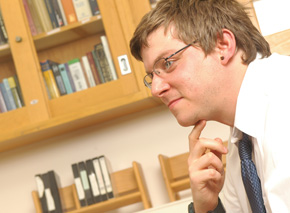
Todd Wyatt discusses findings with Denham.