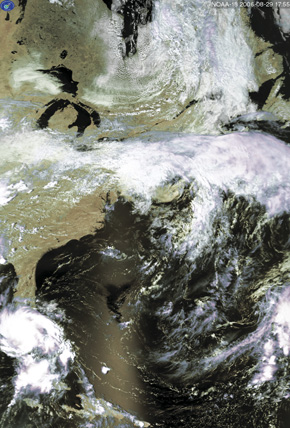

Storm Trackers
New satellite antenna helps researchers track storms in real time
Mason has its antenna up. Specifically, research scientist Guido Cervone, MS Computer Science ’00 and PhD Computational Science and Informatics ’05, and others at Mason’s Center for Earth Observing and Space Research (CEOSR) are using a new satellite antenna that will provide high-resolution, real-time data to more accurately predict where hurricanes will come aground.
“The satellite data, which is fed directly into a forecasting model, significantly improves our ability to track, in real time, a hurricane’s progress,” Cervone says. The data will also be of better quality, allowing the team to study hurricanes with a resolution of one kilometer, which is much higher than the 25-kilometer resolution of previous images obtained by the university.
The timing could not be better for CEOSR. “All current signs point to active hurricane seasons over the next few years,” says Menas Kafatos, co-dean of the College of Science. “Our new technology arms us with the ability to receive real-time data on these storms, so we can better understand their causes and patterns.” CEOSR works closely with NASA in tracking storms.
The antenna provides researchers with data related to, among other variables, sea surface temperature and atmospheric water vapor, factors that are important indicators of a hurricane’s intensity and predicted path. The antenna monitors five National Oceanic and Atmospheric Administration (NOAA) satellites orbiting the Earth, producing data that typically cover the area from the northern border of Canada to the northern border of Mexico.