

Coral Crisis
Mason researchers race to understand a mysterious plague that is destroying the world’s reefs
By Tara Laskowski, MFA ’06
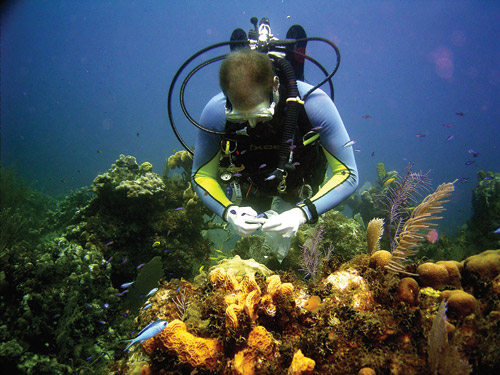
Geoff Cook extracts coral sample
If diving into tropical waters in sunny places sounds like a dream job, think again.
“The coral reefs are dying,” says Mason microbial ecologist Bob Jonas. “[They are] being eaten alive, and we don’t know why.” Jonas, an associate professor in Mason’s Environmental Science and Policy Department, visits the tropics of the Bahamas, the U.S. Virgin Islands, and the Flower Garden Banks National Marine Sanctuary in the Gulf of Mexico several times a year with a team of students to study and do research on coral reefs—and their work is far from sunny.
Being animals, corals have specific diseases associated with them. Approximately 20 known coral diseases have been identified since the 1970s, but the one that concerns Jonas the most is white plague. This disease eats away at the top tissue of the coral, leaving only a limestone skeleton behind.
“I don’t even like to dive on some reef sites anymore,” says Jonas. “It makes me cry to see the reefs in the state they’re in. White plague is like a fast leprosy, and it’s absolutely devastating because the corals never grow back.”

Close-up of coral sample
Jonas and the rest of the team have conducted studies that show that white plague can easily destroy up to one centimeter of coral tissue a day and kill entire small colonies in a matter of days. Since corals grow slowly, perhaps one centimeter a year, this one disease is clearly a major threat. Jonas estimates that 10 to 20 percent of coral in the world is now dead, and the problem is not getting any better.
Even with this dire news, Jonas says he has a passionate Mason team researching and mapping the disease. Along with faculty members Esther Peters, one of the world’s premier coral histopathologists, and Patrick Gillevet, who uses state-of-the-art techniques to study molecular evolution and gene sequencing, Jonas is working to identify the agent or agents causing the disease and the overarching environmental changes that may have developed the disease in the first place.
Geoff Cook, a PhD student in environmental science and public policy, has spent the past three years on this project, scuba diving on coral reefs in the Bahamas, Florida Keys, Dry Tortugas National Park, Flower Garden Banks, Cayman Islands, and Bermuda. As part of his dissertation, Cook has been studying the coral disease known as white plague type II, or WPII, which is known to affect at least 18 different species of reef-building corals in the greater Caribbean region.
Cook has been characterizing the bacterial communities associated with WPII-diseased and apparently healthy colonies of the boulder star coral Montrastraea annularis in hopes of determining the cause of this damaging disease. To acquire his samples, he uses a coring tool to collect multiple sections of coral tissue and skeleton. All samples are processed in the field, then shipped to Mason’s laboratories for further analysis using both culture-dependent and molecular techniques.

Bob Jonas and Geoff Cook process coral samples aboard ship after collection. Both healthy and diseased samples are taken.
“About 99 percent of our time is spent in the lab,” says Jonas.
So far, a specific community of microorganisms that seem to characterize the diseased colonies has been identified; however, the research team is still trying to determine whether this community is unique to the disease and whether it differs in different parts of the world.
The team, which also includes graduate students Paige Rothenberger and Masoumeh Sikaroodi, believes the disease developed because of large-scale environmental factors, the most important being increased water temperature worldwide. Other factors that might contribute include sewage contamination, erosion and sedimentation, and increased ultraviolet penetration.
The National Oceanic and Atmospheric Admini-stration (NOAA) National Undersea Research Program supports much of the Bahamas and Virgin Islands work.?Additional support comes from the Flower Garden Banks National Marine Sanctuary, Florida Keys National Marine Sanctuary, and NOAA’s Coral Disease and Health Consortium.?
Even if the cause of the disease is pinpointed, Jonas is unsure how the problem will be solved. He is hopeful that dedicated scientists will continue to work to save the reefs, not only for the preservation of this strange and beautiful animal, but also for the safety and livelihood of humans.
“Coral is the barrier for the ravages of the sea,” he says. “It is a natural protection for us.”