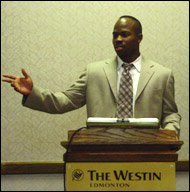
Brian Blake

"Most Promising" Engineer Balances Multiple Roles
By Robin Herron
Although he carries the titles "software systems engineer" and "university professor," Brian Blake, Ph.D. Information Technology '00, is just as proud to be known as "mentor."
That designation, along with his other roles, was a factor that influenced U.S. Black Engineer & Information Technology Magazine to name Blake the Most Promising Engineer in Industry in its 2003 Black Engineer Awards.
Blake is a full-time assistant professor in the Computer Science Department at Georgetown University and a part-time consultant at The MITRE Corporation, a nonprofit company that provides systems engineering, research and development, and information technology support to the U.S. government. He has established himself as a mentor in those settings as well as at Wakefield High School in Arlington, Va.
It all began four years ago when Blake was working on his doctorate and was involved with the Society of Black Engineers' chapter at George Mason. He and two other classmates approached local high schools to see whether they would be interested in starting a science and engineering mentoring program. Wakefield responded enthusiastically.
So, once or twice a month, Blake and his cohorts would take different problem sets to the mostly black or Hispanic teenagers and help them come up with solutions while they munched on pizza. "We might say, 'If you were stuck in the desert with this kind of equipment, what would be the most useful?' We'd do an egg-drop competition or bring in speakers to talk about different careers. Getting them interested in technical degrees was the main goal."
It seems to have worked. At least two of the students eventually applied to Georgetown, and Blake ran into another student at a George Mason job fair where Blake was recruiting for MITRE. "It becomes a really small world," he says with a chuckle.
Blake runs the high school program on his own now, and he has not lost enthusiasm. The program has been funded year by year with help from George Mason, Georgetown, and industry, but, wanting more stability, Blake has applied for a National Science Foundation grant to keep the program going for the next three or four years. "It's a technical grant for agent software, so the students can work with it, play with it, learn about it," he says.
Blake also serves as director of the Minority Mentoring Program at Georgetown, and he's used his position at MITRE to get his students involved in research projects there; two of the students were hired by MITRE after they graduated.
When he's not wearing his teaching or mentoring hats, Blake is making major strides in software engineering research. His Ph.D. dissertation dealt with distributed systems for workflow. "For example, how do you get the components to work together if they're at different locations? The technology makes the components talk together. Later, at MITRE, I used the same type of technology, the same paradigm. Now, we're looking to license it and trademark it," he says.
With no plans to take his life off the fast track in the foreseeable future, Blake hopes to get early tenure at Georgetown. Then he wants to set up a research lab that will allow him to continue investigating, teaching, and, of course, mentoring.