
Classroom Connections: Call of the Wild
Students interact with wildlife in New Century College class
By Colleen Kearney Rich, M.F.A. '95
While many college students were off enjoying leisure and sunshine during spring break, 21 George Mason graduate and undergraduate students spent the week at the National Zoo's Conservation and Research Center (CRC) in Front Royal, Va., learning what it takes to save an endangered species.
The students were participants in Conserving Endangered Species: An Integrative Approach, a New Century College (NCC) course offered this spring and team taught by Mason faculty members Tom Wood, Ph.D. Environmental Science and Policy '96, and Andrew Wingfield, M.F.A. Creative Writing '99, and CRC researcher Katherine Christen. Students had the unique opportunity to live and study at CRC, one of the world's premier endangered species research facilities, where they could try out a number of laboratory and field techniques, such as cryobiology and the use of remote sensing and geographic information systems (GIS). Several CRC researchers lent their expertise and taught units during the weeklong course.
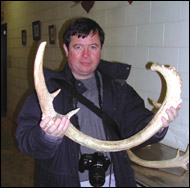
Using hands-on, problem-driven modules, students focused on the wide range of approaches and techniques involved in the conservation of the Eld's deer (Cervis eldi) of Southeast Asia, working alongside the researchers who do this for a living. About the size of the white-tailed deer that are so populous in Virginia, Eld's deer have reddish brown coats and lyre-shaped antlers. A national study in 1998 estimated that fewer than 1,200 deer remained in Myanmar (formerly Burma). About 50 Eld's deer live at the CRC's 3,100-acre Virginia facility.
"In the course, we want students to focus on different aspects of the same problem," says Wood. "This approach provides them with a more holistic look. We also want them to see the value of the group process—no one has ever implemented a conservation program solo."
Wood's affinity for teaching—and CRC—is obvious. He is the impetus behind Mason's partnership with CRC. As a graduate student at Mason, he spent several years working at the center and knows the grounds and facilities better than anyone. His ultimate goal is to one day have a George Mason House "on center," as they call it, where graduate students would live while working there. Currently, a number of researchers live in small houses on center, and a few graduate students from George Mason's Environmental Science and Policy program work out there. In the meantime, he would like the partnership to grow and offer more programs such as this one.
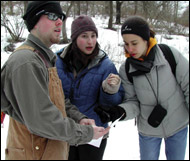
Because it is March, the weather is unpredictable. As luck would have it, the students are scheduled in the cryobiology lab on a warm sunny day, and two days later, a sudden snow storm makes field work—tracking deer—a challenge. Wildlife biologist and CRC researcher Bill McShea leads the students through this field work for his unit on Large Mammal Census and Survey Techniques. As part of the field work, students trapped a native white-tailed deer and put a radio collar on it so they could track its movements. They were then dropped off at various points throughout the center to conduct a field survey of the white-tailed deer population.
Students were organized into groups of at least three, with one person to follow the trail, one to count their paces as a measure of distance, and the third to count deer. Wood and Wingfield drove back and forth across the facility in a van picking up the groups as they emerged from the woods. According to the students' reports, the snow made walking difficult and everyone was having trouble staying with his or her specific tasks. Some groups didn't see any deer; one group maintained they saw the same deer, one with a slight limp, over and over again.
"Then your data are bad," McShea tells them when they reconvene in their makeshift classroom/computer lab/dining hall. They can only count the lame deer once. McShea wants them to understand how difficult it is to collect good data. If this were not an exercise, they would need to go back and get more data. McShea knows about counting deer. He has traveled to Myanmar more than 16 times, most recently in April 2003, and worked with park rangers there to identify and study the remaining Eld's deer population.
For the remainder of the morning, McShea helps the groups enter data into a computer model that could help extrapolate the total number of deer. After lunch, the group joins Dr. Peter Leimgruber in CRC's Spatial Analysis Lab for a crash course in map making and reading.
"All maps are a lie," Leimgruber tells the group. When looking at a map, he urges them to think about two things: "what do you know about this map and what information is not included. Sometimes what is more interesting is what is not on the map."
The afternoon is about MMUs (minimum mapping units), DEMs (digital elevation models), and "bleeding polygons." GIS and remote sensing—mapping using imagery acquired either from aircraft or satellite—have become important tools in the management of natural resources. It is not long before the students are set in front of computers and immersed in the ArcView mapmaking software. Lab assistants are on hand to help students see how data, such as those they collected in the morning, can be translated into visual formats. And all this takes place in just one day.
In other units, the group was given an overview of cryopreservation methods and discussed the conservation history, politics, and culture in Myanmar, particularly as they relate to the Eld's deer population. The course gave students the opportunity to not only gain insight into the natural science perspective, which usually is the only viewpoint presented in conservation courses, but also to view the problem from a humanities and social science perspective as well. At the end of the week, the students presented a Population Habitat Viability Analysis (PHVA), offering their insights into the conservation of the Eld's deer.
"You can talk to students all you want about the complexity of conservation work and the need for interdisciplinary approaches to saving endangered species," says Wingfield. "But in a course like this, students experience the complexity and the rewards of integrative work firsthand, which is so much more effective. NCC's motto is 'connecting the classroom with the world.' Our partnership with CRC helps students make this connection. This is a powerful learning environment."