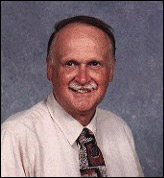
David Rine

Inquiring Minds: No Longer Lost in Space
NASA Lessons Learned system preserves engineering expertise
By Robin Herron
Could the Lessons Learned knowledge-based system that Computer Science Professor David Rine is working on have prevented the Challenger space shuttle disaster? "Probably," he says; however, he's not sure whether it could have prevented the Columbia tragedy because there are still too many unknowns.
As news articles speculating about the cause of Columbia's disintegration have revealed, problems with spacecraft can arise from many factors—damage from the tremendous forces during launch, the failure of mechanical parts, and plain old human error. Add to that list a brain drain of experienced engineers, especially from the National Aeronautics and Space Administration (NASA) shuttle program, and the picture becomes even more complex.
Rine explains that, since NASA began exploring space in the 1950s, it has amassed valuable organizational expertise from lessons learned by its science and engineering community. "But much of the expertise in NASA has been lost. Scientists and engineers are retiring, and they're dying, so there are gaps in the organization's knowledge base."
The NASA-funded Lessons Learned research and development project aims to preserve that expertise and make lost knowledge available to the next generation of engineers. "A project manager working on a mission may wonder, 'Well, have I gone through my checklist of all the things I'm supposed to remember in designing this launch system?' If he doesn't have older, wiser experts with whom to talk these things through, he might miss some things, some very subtle things," Rine says.
The project, which has been ongoing for two years, will produce an ultrasophisticated search engine that can scour NASA databases for important engineering lessons learned.
"The key is to be able to go well beyond the current web browsing and library science technologies and develop ways of retrieving information from the Lessons Learned system that will be literally everything an engineer needs to know about a particular design decision—no more and no less," Rine says.
Rine describes how the search engine would work: "A project manager will phrase what is needed in an engineering decision in his own engineering language. That engineering language will be translated into an internal complex inquiry that the browser will then use to go into the Lessons Learned system and bring back the right pieces of information.
"We want to make these browsers much more usable than they were before. We also want them to be fast and accurate and give the design engineer exactly what he or she needs."
In the case of the Challenger accident, Rine says some people knew of potential problems with the O-rings, but the information didn't get to the right higher-level decision makers when it was needed. He adds that another example of a problem that the system might have helped prevent is that of a spacecraft that went off course during an early exploratory Mars mission because of incorrect sensor readings. Rine, however, acknowledges that the system would be only one defense against errors.
"Because of the size and complexity of the one-of-a-kind systems that NASA puts together, I can't imagine how one wouldn't make some wrong decisions, and you only hope that those are benign, which they often are," Rine says. "Sometimes they're not, and sadly, people get killed." Those are the risks inherent in scientific exploration, he adds.
Rine's association with NASA goes back to when he and his software engineering doctoral students began using Goddard Space Flight Center's databases as a resource for their research. He joined the Lessons Learned project at the urging of his friend, Frank Hoban, who worked for NASA for more than 30 years before becoming director of the School of Public Policy's Continuing Career Program. Hoban, who died last year, had been with NASA during the space program's early days and was deeply committed to preserving space systems knowledge and passing it on to the next generation, a concept that Rine says has now become part of NASA's corporate culture.