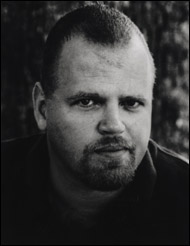
Mark Winegardner

Winegardner Selected to Write Sequel to Puzo Best-seller
Since Random House announced that Mark Winegardner, M.F.A. Creative Writing '87, was selected to write the sequel to Mario Puzo's 1969 best-seller, The Godfather, the references to the book have been flying. It is "the offer he cannot refuse." He is "the next Don." The plot of his sequel is "something he can tell you, but then he'd have to kill you." For a writer, it's been pretty painful.
Winegardner, who directs the Creative Writing Program at Florida State University, was chosen by Random House and Puzo's literary estate to continue the saga about the iconic mob family. Random House editor Jonathan Karp approached Winegardner last fall and asked him to write a proposal for the novel. Karp was looking for someone in the same stage of his or her career as Puzo was when writing The Godfather. Winegardner's proposal beat out well-known writers, such as Vincent Patrick, author of The Pope of Greenwich Village, and crime writer James Carlos Baker. Winegardner's selection to write the sequel, which is tentatively scheduled for release in fall 2004, was announced in February on NBC's The Today Show.
Although this is a big challenge, Winegardner, who already has several fiction and nonfiction books and a collection of short stories published, is used to—and thrives on—big, sweeping epic novels. When writing his first fiction book, The Veracruz Blues, set in Mexico 14 years before he was even born, Winegardner thoroughly researched his subject to bring authenticity to his work. He visited Mexico and read every single page of every 1946 edition of five different Mexican newspapers to get an idea of the mood of the time.
"I like that kind of challenge," he says. "I tell my students this all the time—you are always writing for the experts, always writing for that one person who can read your work and say, 'That would never happen that way!' I think of that person as my friend."
For Winegardner, a sense of place in his writing is important. He also did extensive research for his novel Crooked River Burning, a classic boy-from-wrong-side-of-the-tracks-meets-rich-girl love story that takes place amid the backdrop of Cleveland, Ohio, during the 1940s to the 1960s. "I don't really care for fiction where place is irrelevant. It seems untrue to human existence," he says.
Winegardner grew up in a trailer in Bryan, Ohio (population 8,000), and says that the experiences and the people in that small town still influence his writing. When he was growing up, his parents owned an RV dealership, and Winegardner traveled to all 48 contiguous states before he was 15 years old. "Those two things—being raised in one place and yet constantly seeing the road out the back window of a car or motor home—really did have an impact," he says.
His childhood travels influenced him to write a nonfiction memoir, Elvis Presley Boulevard, which was accepted for publication while he was an M.F.A. student at George Mason. Right before his thesis, a collection of short stories, was due, Elvis Presley Boulevard was accepted by Atlantic Monthly Press. He called his advisor, Richard Bausch, B.A. English '74, and told him that he couldn't get both the revision of his book to his editor in New York and the stories for his thesis to Bausch in the amount of time that both were due. Winegardner remembers, "There was a long pause on the other end of the line, and then Dick said, 'Um, let me explain something to you. Your thesis is something that is going to gather dust on the library shelves until the end of time, and your first book is ...YOUR FIRST BOOK!"
As a teacher of writing for more than 20 years, Winegardner says he enjoys being in the classroom—sometimes more than he enjoys writing. "Writing is hard and humbling. Teaching is a blast. They pay me to talk about books I love. That's kind of a scam."
Winegardner believes that the best part of a writing program is teaching students discipline. He admits that sitting down to write is still the hardest part about being a writer. "It's about showing up. Being brilliant is a function of showing up. You can't be brilliant every day, but you'll never be brilliant any day you don't show up."