 |
 |
|
|
Mason Opens Its First International CampusBy Jeremy Lasich, BA Communication ’98 Mason will truly become an international university when the doors open on its fourth campus in fall 2006 in Ras-Al-Khaimah (RAK) in the United Arab Emirates (UAE). A signing ceremony making the agreement official was held in February in RAK. Campus construction began soon after. “The new campus strengthens Mason’s commitment to international education and outreach, and will give us the ability to serve international students in a new way,” says President Alan Merten. “It will open opportunities for our American students, particularly those involved in conflict resolution, policy studies, Middle Eastern studies, and Arabic language courses.” The campus’ first cohort will include approximately 200 students. Initial programs on the campus will come from the College of Nursing and Health Science, the School of Information Technology and Engineering, the School of Management, and the English Language Institute. The programs were selected based on Mason’s experience in the region and the demand for these disciplines, according to Provost Peter Stearns. In its first year, the new campus will have a computer facility, language laboratory, and basic science laboratories. More advanced facilities, including additional computer facilities, will be constructed in the second year, with nursing laboratories and civil engineering laboratories projected for the third year. A library will also be part of the complex. “The United Arab Emirates provides a significant setting for international activities, based on the openness, dynamic growth, and the advantages of a strategic location,” says Stearns. Most of the project will be funded by the Ras-Al-Khaimah Human Development Foundation, a collaboration between the RAK government and a private company, ETA Ascon Group. Mason will manage the operation. “The willingness of the RAK government to provide an international free trade zone for an American university represents a significant opportunity in itself,” says Stearns. “The new Mason operation will extend the university’s already noteworthy reputation and activity in this region, while providing exciting new possibilities as well.” As the Mason–RAK union gradually achieves its objectives and students in the region gain confidence in the institution at RAK, more programs can be added, leading to a larger enrollment on the campus, according to Stearns. The goal is to expand enrollment to more than 2,000 students within the next 10 to 15 years. The initial intake and the increases envisioned are based on the fact that Mason in RAK will be the first institution of its kind in that region—a campus managed academically by a reputable American university with full involvement in the Middle East. Mason is expected to recruit students from India, Pakistan, Iran, and Saudi Arabia, among other countries. Stearns says that the university will garner several benefits through the agreement, including the opportunity for contact with student groups in the Persian Gulf, which could lead to some direct recruitment of students for programs in Virginia. Under this possibility, students would come to the United States for a year of undergraduate study or master’s degree work. The campus also will greatly enhance Middle Eastern and global student programs on the Virginia campuses, providing opportunities to send students for semester programs or short courses on language, regional issues, global economic, and cultural operations from a different vantage point. Some faculty members will also have the chance to travel abroad to teach in RAK. |
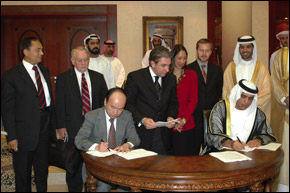
Provost Peter Stearns, second from left, watches as Long Nguyen, a member of Mason’s Board of Visitors, and H.H. Sheikh Saud Bin Saqr Al Qasimi, crown prince of RAK, sign papers. Michele Sison, U.S. ambassador to the United Arab Emirates (in red), also attended the ceremony. |