Many Faces, Many Dreams
Mason’s Early Identification Program celebrates 20 years of transforming lives
By Colleen Kearney Rich, MFA ’95
Photographs fill the walls of Hortensia Cadenas’s office on the Fairfax Campus. Portraits of high school seniors, group shots, and photos of young people mugging for the camera—these are the success stories coming out of the Early Identification Program (EIP). “They are like my children,” she says. “It is just so wonderful to know where they are and how their lives have changed.”
An acclaimed national model, EIP helps high school students go to college and realize their dreams. Middle school students enter EIP at the end of seventh grade. In addition to having high academic potential, program participants are required to be the first in their family to go on to higher education. Participants attend three-week summer academies on the Fairfax and Prince William Campuses each year until they graduate from high school. The academies are designed to prepare the students for academic success by previewing the math, English, and science requirements they will be expected to master in the upcoming school year.
Many program graduates keep in touch with Cadenas, BA Spanish ’80, MA Foreign Languages ’93, who is supported by a staff of program alumni, such as Rhina Ascencio, who graduated from the program in 2003. Currently, she is majoring in English and Biology at Mason and working as an office assistant for the program. Her story isn’t unusual.
“EIP is the greatest thing that has ever happened to me,” says Ascencio. “It changed my life and made me aware of things I would not have experienced on my own.”
EIP partners with six school systems: Fairfax, Arlington, Prince William, Falls Church City, Manassas City, and Manassas Park, using master teachers from those schools for the academies. Cadenas never has problems finding help.
“The same teachers come back year after year. They love working with our students,” Cadenas says. “And when someone does have to leave our program, they always have colleagues they want to recommend.”
To augment the academic preview, EIP offers SAT preparation, computer technology classes, cultural field trips, and ongoing tutoring throughout the year. And just as important, EIP mentors the family along with the student by offering workshops for parents on communications, navigating the financial aid system, and an overview of what exactly is needed for college preparation. Many EIP students come from single parent families, and often there is a language barrier for the parents.
For EIP graduate and Mason alumna Margarita Jaramillo de Abreu, BA English ’05, having someone who was able to communicate with her mother in Spanish was an important component of what EIP had to offer. She and her mother emigrated from Colombia when she was a toddler and shared the same dream—for her to graduate from college.
“Her career goals have always been mine,” says Jaramillo de Abreu of her mother. “We came to this country to give me a different opportunity, a chance to carve my own way.” And she has—she now holds the coveted position of tutoring coordinator for EIP, a job that has been held by a succession of EIP grads. She also plans to work on a master’s degree in counseling at Mason.
EIP was started in 1987 as part of a partnership between the university and the Fairfax County Area II Public Schools. Data showed that minority student enrollment in college was low, because when the students reached college age, they weren’t prepared. Realizing that outreach to these populations needed to begin much earlier, E. Wayne Harris, then the Area II superintendent, suggested starting a program. EIP was born as a pilot program funded by the State Council of Higher Education for Virginia.
EIP students are referred by guidance counselors and teachers. Since its inception, more than 700 students have successfully completed high school, with many going on to such universities as Penn State, Johns Hopkins, and William and Mary. A large number of the program graduates attend Mason, thanks to a growing scholarship program. More than 100 hold Mason degrees.
Support for the program has increased over the years, as have the number of scholarships the program is able to award. EIP has also garnered numerous awards for its efforts over the years, including two invitations to the White House and being singled out by President Clinton as one of the top 18 programs in the country promoting partnerships between colleges and middle and junior high schools. Currently, in its 20th year, the program has more than 500 students enrolled.
“Every time I take a tour of the summer academies, I come away more excited about the program,” says university president Alan Merten. “I’m excited about what people are learning, but I’m just as excited about what people are becoming as a result of what they’re learning and who they are learning from. It is one of the highlights of the year for me.”
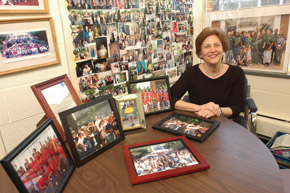
Hortensia Cadenas in her office with photos of the program’s many graduates