
Armor All
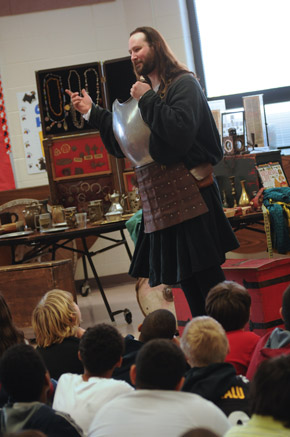
Andrew Young with class at Bonnie Brae Elementary in Fairfax.
Mason alumnus has dedicated his career to making clothes that make the man—and history
By Elizabeth Grisham, BA History ’02
In an age when much historical information exists either between the covers of books or in online databases, one alumnus is working to put a human face—and an accurate outfit—on the past.
Andrew Young, BA History ’00, is a historical and cinematic reproductions specialist and speaker, who brings the past to the present. His latest project is to craft a suit of armor for a client to wear during interpretive living history events in Jamestown, Virginia.
“I am making a highly accurate reproduction of a late 16-century suit of armor for him,” says Young. Drawing from nearly 20 years experience as an armorer, Young says the suit will depict the armor worn by settlers and, in particular, a free man, whom his client will portray.
Young’s research has revealed that this client’s character would likely have owned a higher-quality munitions armor that has the same shape and proportion of suits belonging to wealthier knights and nobles, but its surface would not be as highly polished as that of the highest-end suits.
For these kinds of projects, attention to detail is important. Young has found that some living history participants imitate the smallest details of settlers’ dress, right down to their underwear.
But determining what a Jamestown settler would wear is only a small part of Young’s work. He could be doing highly researched and re-created historical work, sculpting a movie costume piece, sewing or working on a gun holster, and making a pair of shoes—all in a day.
While a student at Mason, Young focused on armor studies and the history of technology. “The interconnectivity of life and technology fascinates me. I found amazing connections between the advancement of armor and weaponry and that of navigation, art, and artistic perspective that were completely due to metallurgical advances,” he says.
In addition to his armor work, Young also creates museum reproductions and has given more than 1,000 presentations in the public schools. He speaks to students on medieval society, major historical events and figures of the era, and the possessions that shaped medieval lives. By addressing these topics, he hopes to get students interested in what they’re studying, challenge historical stereotypes, and inspire critical thinking and discussion.
“Depending on the age of the audience, which is a big factor, I try to impress upon them the importance of understanding the technology and material culture of the day as a way to truly understand what people were thinking and yet see how similar they remain to us despite the vast difference in our technological sophistication.”
To aid in this goal, Young brings many reproductions and artifacts to his presentations, including jewelry and historically accurate clothing. “I want students to see how people other than nobles and knights lived and dressed. Both the armor and the clothing are important,” he says, “because they give students some mental imagery and enhances their learning.”
Young also dons period clothing and armor intended to represent that of a typical medieval knight and lesser noble from about the early 15th century. The clothing and armor, which he has sewn himself, includes woolen leggings, linen undergarments, various woolen gowns, and leather turnshoes (medieval shoes).
Although Young says he tries to keep his attire modest and accurate in the name of learning, he does enjoy students’ reactions to his wares.
“That’s the crowd pleaser. Most people don’t see a guy put on a suit of armor,” Young says. “I love seeing the students’ faces light up when they see all the cool stuff. I feel a bit like Santa Claus.”