



- Sharing the Gift of Music
- The Birds and the Bees and the Elephants
- From Last in the League to Field of Dreams
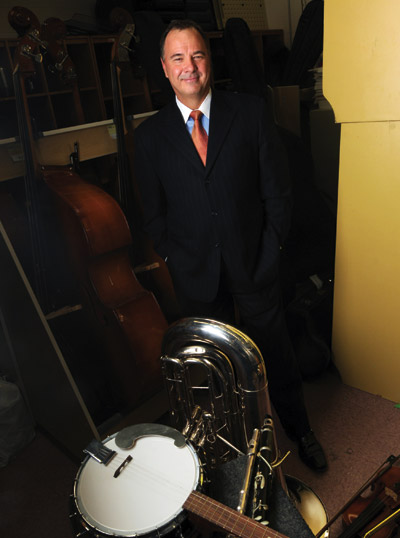 Sharing the Gift of Music
From an early age, John Paul (J. P.) Phaup, MBA ’91, was musically inclined. Born in the same town that produced the Beach Boys, he was his school district’s number 1 percussionist for several years running. “I was a little drummer boy,” he says.
Fast forward a few decades and Phaup, now managing director, investments at Wachovia Securities, was enjoying lunch at the Country Club of Fairfax when he overheard a couple of men talking about the need for a new music hall at Mason. Turns out that College of Visual and Performing Arts (CVPA) Dean William Reeder and Charles Joyce, the Arts at Mason Board chair, were two of the dining companions.
Being interested in helping his alma mater and having an interest in music, Phaup decided to get involved. And when he does something, whether it’s playing the drums or raising money for the arts, Phaup does it whole-heartedly. He’s now vice chair of the Arts at Mason Board and also a trustee of the George Mason University Foundation.
But it was a used trumpet that provided the inspiration for his latest venture: starting the Instruments in the Attic donation program that will benefit Mason’s music students and area schoolchildren. Phaup was chatting with a friend from the office when his colleague mentioned that his wife had gotten him a new trumpet for Christmas. Phaup inquired what his friend was doing with his old one.
“I said, ‘You give me that trumpet and I’ll make sure some kid gets it.’ So I brought it to an [Arts at Mason] meeting and said, ‘All right, we’ve got a trumpet. What are we going to do with it?’”
It was around that time that John Casagrande, codirector of music education in CVPA, concluded that Mason’s own music students needed an additional 149 instruments. Phaup was shocked. “Who would think that?” he marvels.
“What we all learned was that if you’re a music major at Mason, you have to be proficient in playing 16 instruments to a level where you can teach a kid to play it and also know how to keep the instruments in good repair,” he explains. So students were renting instruments or borrowing from their friends, says Phaup, to pass their academic requirements and gain instrument proficiency.
The result is the Instruments in the Attic program. Launched in September, the program was officially announced at a Mason holiday concert in December where Phaup served as a guest conductor. The program’s objectives are to receive enough instruments to meet the needs of Mason’s music majors and donate the rest to local schools where Mason music grads often end up teaching.
Phaup says the program is a win-win situation. Donors get rid of their old instruments and get a tax deduction in return, but “the greatest winners, we hope, from this will be the kids, who’ll get an instrument and a teacher [from Mason].”
To date, 81 instruments have been pledged or donated to the program, which is being managed by the Music Department. For more information on how you can help, contact Kerry Doran at 703-993-8877 or [email protected].
—Leah Kerkman Fogarty
The Birds and the Bees and the Elephants
Just as humans reveal a lot about themselves through their behavior, animals do the same. And for animal behaviorists such as Elizabeth Freeman, PhD Environmental Science and Policy ’05, any sneeze, dance, or stomp could be the key to unlocking the mystery behind why animals do what they do.
 Freeman originally thought her love for animals was going to take her to a career as a veterinarian; however, as she took more and more classes in college, she realized that her true passion lay elsewhere.
“I really got excited by the ecology classes I was taking and started to rethink things. I thought that maybe studying animals would be more exciting to me than vet school,” she admits.
Freeman was naturally fascinated by the way animals behave and the complexity of their behavior. At Virginia Commonwealth University, she studied the mating behavior of a fruit fly-size wasp to determine whether its behavior was a courtship dance. (It was, indeed. When they didn’t dance, the male wasps didn’t get to mate.)
Later, when she relocated to the Washington, D.C., area to study at Mason and work with the Smithsonian National Zoological Park, Freeman set bigger goals— literally—moving from insects to elephants.
Researchers at the zoo realized that one-third of the female African elephants in North America were not having a normal estrous cycle and therefore were unable to get pregnant. While they looked at possible physiological reasons for this, they brought Freeman in as a behaviorist expert.
Freeman’s research took her across the country to 15 different zoos. She investigated whether the problem was related to their environment or might lie somewhere in the animals’ social structure. Elephants live in a tight society led by the matriarch, typically the oldest female in the group. In other species with matriarchs, these dominant females can suppress submissive females from cycling, and Freeman thought this might be what was happening in captive elephants.
But that was not the case. What she found instead was that the dominant females were the ones who were not cycling. With this knowledge, she is now looking to see whether as female elephants get older, they go through menopause just as humans do.
Along with her interest in increasing the reproductive success of zoo elephants, she also studies elephants in the wild. When she’s not teaching in her new position in New Century College at Mason, she travels to Africa each year for two to three weeks to work with about 400 elephants in the Addo Elephant National Park in South Africa, where she and her research assistant use fecal samples to analyze the hormone levels of the elephants to determine their cycles.
Freeman took methods used in the National Zoo’s Conservation and Research Center laboratory in Front Royal, Virginia, and altered them slightly so that they can use these methods in the wild for much less cost.
“I’m calling it the ‘Elephant Clear Blue Easy Test’ because it is sort of the same concept as a home pregnancy test. We can measure their hormones based on a simple color change,” she says.
Despite her engaging research in the wild, the captive population is near and dear to Freeman’s heart. She believes that having captive animals is beneficial to science and the community. She calls these animals “ambassadors” to their wild counterparts and believes that they allow researchers to learn things about them that are not always possible in the wild. In addition, zoos educate people about the beauty and behavior of these animals, as well as their plight in the wild.
“The majority of Americans will never get to Asia or Africa in their lifetimes, so if there were no zoos, they would never get to see these animals up close and in person,” Freeman says. “These more personal associations engage people to care about wildlife in ways that two-dimensional print or video material never can.”
—Tara Laskowski, MFA ’06
From Last in the League to Field of Dreams
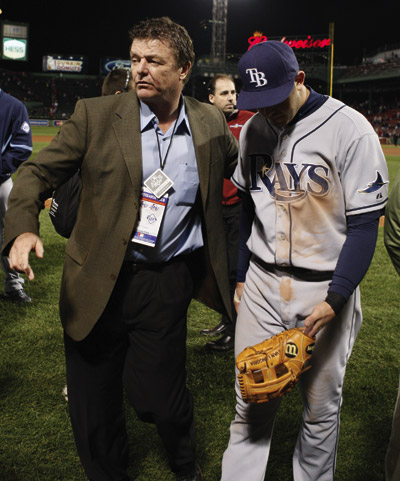
Rick Vaughn at the American League Championship Series at Fenway Park with 2008 American League Rookie of the Year Evan Longoria.
2008 was such a crazy year for Rick Vaughn, BSEd Health Education ’79, that he knew it would be December before he could really process it all. Even then it felt as if it had been a dream.
After 23 years working in major league baseball (MLB), Vaughn, vice president of communications for the Tampa Bay Rays, went to the World Series, a first he shares with his team.
“When the champagne is flowing and it is your team, the feeling is indescribable, and it is still hard to believe it happened,” says Vaughn. But the evidence is everywhere. Even in the middle of winter, Vaughn says he still sees people in Rays’ gear each time he goes outside.
In many ways, the Rays had been viewed as second-class citizens, he says, and what they have been able to accomplish—going from the team with the worst record in the league to the World Series the very next year—is rare and has only been done by one other MLB team.
“[Going to the World Series] was very special for the team, but it was also very rewarding to see the fans come together and get behind the team,” he says. “We were the underdogs and became such a great story. There was so much media attention.”
The similarities to his alma mater’s 2006 trip to the Final Four did not go unnoticed. “One morning I was in the car listening to Dick Vitale on the radio—he’s one of our season ticketholders—and he said, ‘you know who this team reminds of …George Mason,’” Vaughn says and laughs.
Vaughn has his own glory days at Mason to look back on. A pitcher for Mason’s baseball team while a student here, he threw the school’s first no-hitter in 1976, during his sophomore year. Mason baseball coach Bill Brown was his catcher.
It is also where he began his career in sport information. Back then, the campus sports information office was run by student volunteers, Vaughn being one of them. When he graduated, they offered him a full-time paid position. He only stayed a year, quickly moving on to director positions at area universities such as Catholic and American before making the jump to MLB as an assistant public relations director for the Baltimore Orioles. He even enjoyed a brief stint with the Washington Redskins in the early 1990s before returning to baseball.
“I am a huge Redskins fan,” he says. “But my calling and my heart have always been with baseball.”
Vaughn continues to stay in touch with his former teammates, and when the Rays are in town, it isn’t unusual to find a group of them catching up at Brion’s Grille. But lifelong friends weren’t the only thing Vaughn found at Mason, it is also where he met his wife of 29 years, Sue Peluso. The Vaughns have two daughters: Amanda, who just graduated from the University of Florida, and Elissa, a sophomore at the University of Central Florida.
While Vaughn has managed to catch up on his sleep since the World Series whirlwind in the fall, things haven’t slowed down for him or the Rays as they begin spring training. And as the Cinderella team, the spotlight is still bright on the Rays.
“There is never much downtime, but I love it,” he says.
—Colleen Kearney Rich, MFA ’95