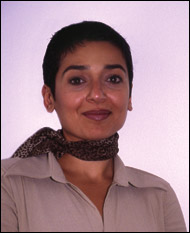
Zainab Salbi
Be the Change
Mason alumna strives to bring about global change—one woman at a time
Zainab Salbi, B.I.S ’96, is on a mission. She works to help women suffering from post-war trauma and to educate the rest of the world about their plight. A tiny woman with a fierce and passionate voice, Salbi has gotten herself and Women for Women International, an organization she started while still a student at George Mason, noticed by many people. And she’s still talking, hoping more will listen.
Iraqi-born, Salbi came to the United States at age 19 and founded Women for Women in 1993 in a church basement. The nonprofit organization provides women survivors of war, civil strife, and other conflicts the resources to move from being victims of crisis and poverty to self-sufficient, active citizens who promote peace and stability. The organization has assisted more than 20,000 women and 90,000 family members in countries such as Bosnia and Herzegovina, Kosovo, Rwanda, Nigeria, Afghanistan, Colombia, and Iraq.
The organization provides women aid in three ways. The first is financial aid, which comes in the form of direct aid or loans. The organization has already distributed nearly $10 million. In countries such as Kosovo, women design, make, and sell crafts and goods in stores the organization helped start. On the organization’s web site (womenforwomen.org), visitors can shop for some of these goods at a virtual bazaar with the proceeds going directly to the women. In addition, another program directly connects a sponsor to a woman in need, putting a name and a face to the women being helped and closing the gap between cultures and continents to promote understanding and change.
The second form of aid provides women vocational skills and training, but the type of training depends on the women’s country and culture. “Many organizations will show you pictures of women learning to sew. But in countries where sewing and tailoring is a male-dominated profession, these skills would not be practical for women,” says Salbi.
The final area of support, and perhaps the most valuable, is women’s rights training. Salbi says that women survivors of war and oppression need not only money, but also need education and empowerment to make their own decisions. When people ask why impoverished women support fundamentalist religion over democratic solutions, Salbi says it is most often because fundamentalist groups offer food to the women’s starving families. “A lot of these women see these groups as their only way out, as a choice between life and death,” says Salbi.
By educating and empowering women, the organization also is more effective in evoking change to ban oppressive practices, such as female genital mutilation. Women for Women gives the women the facts about such practices and the support to work from within their society to promote change.
One factor contributing to the organization’s success is that its staff members are native to the country in which they are stationed. And their success shows. In the past few years, several women in Rwanda pooled their money to buy a sewing machine and start a tailoring business. In Nigeria, widows who become impoverished because of a ritualistic cleansing are supported by Women for Women through leadership training. Subsequently, these women are being appointed to decision-making roles in their communities.
“Zainab is strong, determined, and relentless in her pursuit of equity for women,” says Connie Kirkland, coordinator of Sexual Assault Services at Mason, who team taught a Women and the Law course with Salbi in the mid-1990s and recently invited her back to the classroom to speak. “She listens intently, and she learns incredibly fast. She understands women’s issues, and she believes in the capacity of every woman to grow, persevere, and move forward when support is offered.”
Salbi has appeared on Oprah Winfrey’s show four times and was honored by President Bill Clinton in a White House ceremony for the organization’s work. Women for Women has also been nominated for numerous awards, including the Conrad Hilton Humanitarian Prize and the Center for Economic and Social Rights for John F. Humphrey Freedom Award.
“There is no secret, no magical solutions to the problems of these women,” Salbi says. “But with education and empowerment, we make a difference every day in their lives. Our contributors and donors make the dream possible.”