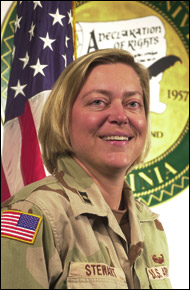
Allison Stewart

Bringing Home the Bronze
Army captain awarded for operations research efforts in Iraq
By Robin Herron
When Allison Stewart, M.S. Operations Research ’02, jumped down from a Chinook helicopter to the sizzling tarmac of Baghdad International Airport last June, she never guessed she would leave three short months later with a Bronze Star stuffed in her backpack. Only a week earlier, Stewart, an Army captain, had learned that her first deployment after being in the military for more than nine years would be to the very center of operations in Iraq.
After getting her master’s degree at George Mason under the Army’s advanced schooling program, Stewart was assigned to the prestigious Center for Army Analysis (CAA) at Fort Belvoir, Virginia, as an air defense analyst. When she heard that an operations research/systems analyst (ORSA) post in Kuwait was available, “I immediately volunteered because I’ve been wanting to be deployed since I’ve been in the Army—I’m single, no kids,” she explains. But instead of being sent to Kuwait, she was sent to Iraq. Her tour, which began as the guerilla attacks on U.S. troops began to intensify, was set at three months because the need for her skills was expected to be short term.
When Stewart arrived, she found that no one really knew what an analyst did even though one had been requested, so she was able to structure her own job. “I started working on what we call measures of effectiveness, or what the news media call ‘metrics,’ to determine how we were doing over there.”
Maj. Gen. Ricardo Sanchez, the commanding general who assumed command of coalition ground forces about the same time Stewart arrived, had a particular interest in measures of effectiveness, being a trained ORSA himself. “He had me work on improvised explosive devices—when were they occurring, what were the actual numbers, on what day of the week were they occurring, what time of day were they occurring—and give some insight into what was happening and the patterns that they were doing it on. I did a similar analysis for mortar attacks.”
At the same time, Stewart was communicating with government agencies and CAA in the United States so their statistics would be coordinated. “We had some data collection issues over there. They didn’t know anything about numbers. They didn’t know how to collect data. They didn’t know how to track what had been happening. So I had to do a lot of that. We didn’t have a lot of data to work with at first.”
In the short time she was there, Stewart’s efforts had an instant impact. For example, the operations officer began to use her data in his weekly briefs to the commanding general. “They basically started to understand how to do their own charts to show how the attacks were occurring. That stuff came up daily in infrastructure attacks—attacks on power and oil structures. The engineers started to look at those numbers also, and that all came out of the work we did.”
Barracked and working within the secure inner perimeter of one of Saddam Hussein’s larger palace compounds on the outskirts of Baghdad, Stewart says she always felt safe, although she could hear gunfire almost every night as U.S. troops patrolled the outer perimeter. That was why she was all the more surprised to receive the Bronze Star, widely understood to be given for heroism but also presented for service or achievement in a combat zone, on the morning she left Iraq.
Expecting a lesser award, Stewart says, “I can only go by what the award says—they basically decided that the work I had done was that critical to the war effort that it warranted a Bronze Star.”
Back home, Stewart has become a celebrity of sorts in the Army operations research community. She’s been deluged with requests to give debriefings to analysts all over the country and even found herself in George Mason’s OR 652 class—this time as a teacher rather than as a student.