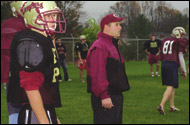
Joe Thompson (center)

All the Right Moves
For one group of alumni, football is definitely a thinking man’s game
By Colleen Kearney Rich, M.F.A. ’95
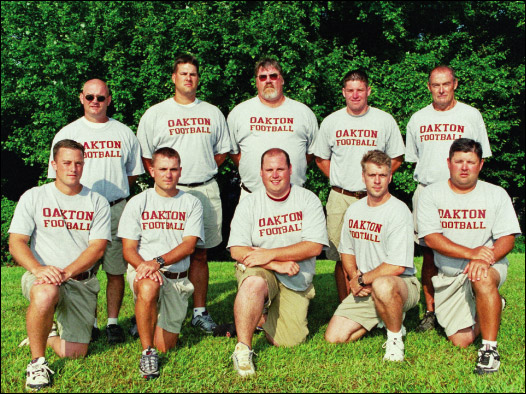
They might wear burgundy and gold all the time, but the entire coaching staff of Oakton (Virginia) High School’s varsity football team are green and gold Patriots, one and all.
Joe Thompson, B.A. English ’94, leads the team as head coach and quarterback coach. He is assisted by Jason Rowley, B.A. History ’99, defensive line coach; Rick Wells, M.Ed. Education Leadership ’01, offensive line coach; Brian McGowan, B.S.Ed. Physical Education ’90, defensive back coach; and J.J. Hetman, B.S.Ed. Physical Education ’95, running back coach. Donny Samson, co-head coach of Oakton’s junior varsity team, is still a Mason student, majoring in accounting.
What could cause such a high concentration of Mason grads in one place? Basically, they are hometown boys at heart. Everyone on the coaching staff is a product of the Fairfax County Public Schools where they now all teach. Even those who strayed from Northern Virginia (Thompson attended Clarion University in Pennsylvania for a time, and Wells’s bachelor’s degree is from William and Mary) all found their way back to the region—and football.
The 2003 season was Thompson’s 12th year of coaching, but his first year as Oakton’s head coach. Prior to Thompson’s tenure, Pete Bendorf, B.S.Ed. ’85, M.Ed. ’01, was the school’s head coach for 12 years. Bendorf is now the athletic director at James Madison High School in Falls Church, Virginia, but he left Oakton on a high note. In 2002, the Cougars won the regional championship.
For Thompson, coaching and sports are a way of life. His father, now the men’s basketball coach at Hayfield Secondary School, has coached in Fairfax County for more than 30 years. Thompson even played for his father while attending Lee High School in Springfield. Thompson, who also teaches special education at Oakton, began his coaching career while still a student at Mason.
“I have the opportunity—on a day-to-day basis—to be part of the development of teenagers,” he says of coaching and teaching. The best part about coaching is that “they want to be there and you want to be there. These are motivated kids when they get out on the field. They just want to get better at what they are doing—which makes for a great working relationship.”
But Thompson and his fellow coaches have made it clear that prowess on the playing field is not enough, students are also expected to excel academically. And the coaches strive to help the kids stay sharp. Thompson and Wells are known among the players for their use of SAT vocabulary words.
“There is a marriage between academics and athletics. You can’t be successful in one without the other,” he says. “To me, it is the same thing. You are trying to master a skill—whether it is solving a math problem or throwing a football through a tire. I’m competitive enough that I’m not leaving until I figure out how to do it right.”
“[Football] is not about physical brute force,” he continues. “It is about strategy, how quickly can you outthink the other player and problem solve. And finding a way to teach that to a bunch of kids—that’s the challenge.”