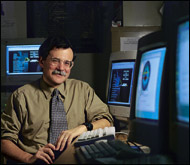
Roy Rosenzweig
Rosenzweig Honored with Distinguished Humanities Award
Roy Rosenzweig, director of the Center for History and New Media (CHNM) and distinguished professor of history, has received the second Richard W. Lyman Award, presented by the National Humanities Center. The $25,000 prize recognizes scholarly achievement of unusual merit and impact and innovative use of information technology in humanistic scholarship and teaching.
Rosenzweig was acknowledged for his work with CHNM, particularly web-based projects such as the September 11 digital archive and the History Matters project. These projects are attempts to make new and rare historical documents free and accessible to anyone and explore how technology can be used to enhance the study of history. More information can be found at the center’s web site (chnm.gmu.edu).
The main principle behind Rosenzweig’s research is the attempt to democratize history. “By democratizing history, I mean democratizing the audience—reaching wide and diverse audiences; democratizing the content—incorporating diverse voices, especially the voices of ordinary people; and democratizing the practice—making history open and collaborative,” he said.
A graduate of Columbia College who studied at St. John’s College of Cambridge, England, Rosenzweig received a Ph.D. from Harvard University. He is coauthor, with Elizabeth Blackmar, of The Park and the People: A History of Central Park, which won the 1993 Historic Preservation Book Award and the 1993 Urban History Association Prize for Best Book on North American Urban History. He also cowrote, with David Thelen, The Presence of the Past: Popular Uses of History in American Life, which won prizes from the Center for Historic Preservation and the American Association for State and Local History.
Rosenzweig’s multimedia CD-ROM, Who Built America? From the Centennial Celebration of 1876 to the Great War of 1914, with Steve Brier and Joshua Brown, was a finalist in the first Interactive Media Festival and won the James Harvey Robinson Prize of the American Historical Association. He received a Guggenheim Fellowship and lectured in Australia as a Fulbright professor.
“Roy Rosenzweig has helped historians understand how new developments in information technology transform the ways that they research, write, present, and teach about the past,” says Peter Bardaglio, a member of the Lyman Award selection committee. “The Center for History and New Media has been at the forefront of producing historical works in new media, testing the effectiveness of these products in the classroom, and reflecting critically on the promises and pitfalls of new media in historical practice.”
Honoring Richard W. Lyman, a past president of Stanford University and the Rockefeller Foundation, the award is made possible through a grant from the Rockefeller Foundation.