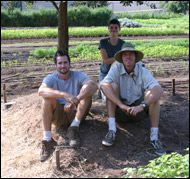
Franciosa, right, with coworkers

Community Roots Grow Deep with Urban Farmer
After admiring a small plot of land in the middle of Sacramento, California, two young men knocked on the door of the woman who owned the spot. When she didn’t answer, they left a note in her mailbox, asking if they could use her land. “We’ll give you free food if you let us farm your property,” the note said.
The note’s authors were Marco Franciosa, B.A. History ’94, and his business partner, Shawn Harrison. Interested in helping the environment in a positive way and having some experience with urban farming, the two wanted to start their own organic farm in the middle of the city. The woman called them the next day, willing to give it a try. Franciosa and Harrison leased the property “for $1 and free vegetables every year.”
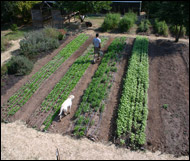
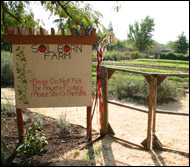
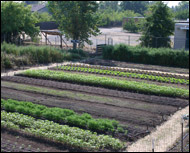
Now, about four years later, Soil Born Farm has ripened into a full-production, certified organic farm, and Franciosa and Harrison are reaping the benefits. As for the landowner, she gets a lot of vegetables.
Depending on the season, the farm yields carrots, beets, lettuce, broccoli, squash, tomatoes, peppers, eggplant, and potatoes. This year the partners also focused on growing arugula. Franciosa, who lives on the farm, says the work is difficult but fulfilling.
Franciosa managed a restaurant for a year after graduation from Mason and admits he never saw himself as a farmer. A few years later, Franciosa joined AmeriCorps, a network of national service programs that provide Americans needed assistance in education, public safety, health, and the environment. This experience changed his life and career path.
His AmeriCorps assignment landed him in Washington, D.C., setting up organic container gardens for children in public housing. Containers had to be used because the neighborhood soil was so contaminated that nothing would grow in it. He learned a lot about organic farming, which uses no chemicals and employs a number of environment-friendly practices that do not deplete the soil. “I saw a strong connection between people and growing their own food, and it was a powerful way to create social change. I wanted to continue that but I realized that I didn’t know anything about gardening,” he says.
That changed quickly. Not afraid to get his hands dirty, Franciosa worked hard on several organic farms, learning the territory, the practices, and the philosophies behind this type of farming. He earned a certificate in ecological horticulture from the University of California at Santa Cruz, where he met Harrison. From there, their ideas really took off.
“We felt there was a disconnect between people and their food systems in the city, and we wanted to bring the food right to the people and get them involved in the farm,” Franciosa says. This year, they will initiate the Urban Agricultural Project, creating a nonprofit organization to begin teaching hands-on horticultural classes and job training on the farm, and developing projects to make organic food accessible to low-income communities.
Franciosa and Harrison sell mainly at farmer’s markets and to local, high-end restaurants. The restaurants especially love them because of their proximity and high-quality produce. “We can give them whatever they need. If they need 15 pounds of squash for their evening special, we can get it to them in five minutes,” Franciosa says. “They love us.”
“During the season, we work between 10 and 13 hours each day.” Franciosa says. “When I’m working, I never look at my clock, and that has to say something.”
“I love farming,” says Franciosa. “It’s a passion. At the end of the day, I can walk in my house and know everything I’ve done was positive—for the environment, for myself, and for my customers.”