
Course Turns Vandalism into Works of Art
When a serial vandal cut up 607 books from the San Francisco Public Library, he had no idea that a group of 39 students from New Century College (NCC) and the Department of Art and Visual Technology (AVT) would spend several weeks working to put those books back in circulation as art.
The vandalized books were on such subjects as women’s health, AIDS, and gay, lesbian, bisexual, and transgender topics. Because of the books’ content, the vandal was charged with a hate crime. The library called the project “Reversing Vandalism” and asked that each student transform one of the damaged books. The George Mason students were the only college art class to take on the project.
The students were enrolled in Art as Social Action, a special topics course offered jointly in NCC and AVT this past fall. Suzanne Scott, instructor in NCC’s arts and culture concentration, and Lynne Constantine, associate chair of AVT, team taught the class.
“The premise of the course was that all art engages with the larger social world and has a stance, whether it announces its stance or not,” says Scott. “But citizen artists make their art with the express purpose of becoming agents of social commentary, social protest, community improvement, individual and world betterment, and even radical change.”
The students came from a diverse mix of backgrounds, ages, and interests. Many were visual artists, musicians, and dancers; others were more interested in the historical, cultural, and social aspects of art. “The students immediately understood that this was a restorative justice project and it was about a core value of democracy—freedom of thought,” says Constantine. “They especially understood the importance of returning these books to the library, where they would be placed back in circulation, though in an altered form.”
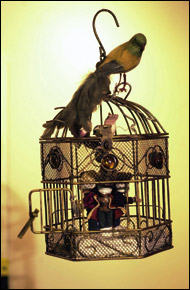
Some of the students pulped the books and created works from the paper. Others kept recognizable parts of the text and incorporated them into paintings and mixed media pieces. One student used a synthesizer to compose a 12-movement musical piece based on the characters in his book, while another student majoring in events management produced a table setting with flowers and a bound proposal with pictures of the planned event.
The students’ works were shipped to San Francisco, where they will be exhibited with other artists’ transformed books at various branches of the library this spring. The exhibit will include a display that documents the students’ process.
“Art produced as social action is meant to stimulate connections and conversations between the viewer and the object, between the artist and the viewer, and among the viewers themselves,” says Constantine. “Our goal for our students was to not only learn about exemplars of this type of art, but also to experience what it’s like to make those conversations happen.”