


Lorin Thompson, Mason's First President, Dies
 |
By Daniel Walsch
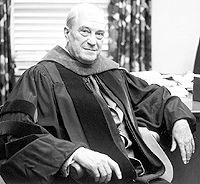
Lorin Thompson, former president of George Mason University and one of the key figures in the institution's history, died March 13, of complications resulting from pneumonia. He was 97.
President Alan Merten called Thompson's passing "a sad day, yet an opportunity for us to reflect on the tremendous contributions he made to our institution, our region, and the Commonwealth of Virginia."
"In many ways, it was Dr. Thompson's vision of what George Mason University could be, both to its students and the Northern Virginia region, on which our institution has been built," said Merten. "Through his commitment to higher education, his long-range thinking, and his steady leadership, he was able to provide us with a solid foundation on which our campus continues to evolve."
Thompson came to George Mason in 1966 as chancellor of what was then George Mason College. At the time, it served as a two-year satellite campus of the University of Virginia (UVA). Thompson had been director of UVA's bureau of population and economic research since 1958 when he was asked to take over as George Mason's chancellor following the resignation of its top administrator, Robert H. Reid.
An expert in "growth," Thompson originally came to Virginia in 1940 to direct a comprehensive population study for the Virginia State Planning Board. Shortly before his appointment as George Mason College's chancellor, the Virginia Senate had approved legislation that expanded George Mason College from a two-year to a four-year institution. It was felt Thompson's administrative skills and his expertise in demography would enable him to guide George Mason in its expansion.
One of Thompson's first challenges was to work closely with the state's Board of Control to acquire 421 additional acres for George Mason. This was the amount of land recommended by the Northern Virginia Regional Planning and Economic Development Commission.
At a meeting before regional leaders, Thompson said, "The people of Northern Virginia have a unique opportunity to provide for the orderly growth and development of a university in this area. If we don't get this land now while it is unoccupied and available, it will limit the ways in which we can develop. We will have to resort to piecemeal, patchwork development."
Thompson was successful in acquiring this additional land for George Mason. This marked the beginning of George Mason's "growth spurt" in terms of land acquisition, buildings, student enrollment, and degree programs that continued for the rest of the century and ultimately captured the attention of the nation's educational community.
Thompson served as George Mason's chancellor through 1972. That year he was named president of the institution and held that title until his retirement in 1973.
During his tenure as George Mason's chief executive, student enrollment grew from 840 to more than 4,000, the campus more than tripled in size, and the institution gained university status.
"He was the first person who envisioned George Mason could become a major metropolitan university," said history professor Robert Hawkes. Hawkes served as assistant director of UVA's extension center at the time Thompson came to George Mason. "He was a man who looked to the future, who generated trust, and was able to establish strong and close ties between our institution and many key people and organizations in Northern Virginia."
In April 1981, George Mason honored Thompson on University Day. As part of the celebration, Mills Godwin, who was governor in 1966 when Thompson became chancellor, said, "This university, in a very special way, bears testimony to his vision, good judgment, and tireless efforts. He brought integrity, ability, dedication, and experience that reaped great dividends during his tenure and established the firm foundation from which George Mason would emerge into a university of unlimited potential."
A native of Greeley, Colo., Thompson is survived by his wife, Amelia, along with 7 children, 20 grandchildren, and 21 great-grandchildren.